Netscape versus Microsoft · 1995–2001
A browser becomes a position of power
In 1995 Netscape looked unassailable. Navigator was fast, recognisable and, for many users, simply was the Web. Microsoft started far behind, but released new versions of Internet Explorer at high speed and tied the browser ever more closely to Windows. Within a few years, the balance had reversed.
The contest became known as the browser war, yet that phrase hides how much was at stake. Whoever controlled the browser influenced which home page people saw, which technologies web builders used and which services opened by default. A button, a setting or a proprietary fragment of HTML could steer millions of users.
Internet Explorer enters a market dominated by Netscape.
IE4 and Communicator 4 turn features and distribution into an arms race.
Microsoft integrates IE further; Netscape opens Communicator’s source code.
IE has passed Navigator. A US judge finds that Microsoft abused monopoly power.
Microsoft dominates the desktop; the parties reach a proposed settlement.
Every new feature became a lure
Netscape had set the pace in the early years with cookies, JavaScript, frames and plug-ins. Microsoft responded with proprietary extensions such as ActiveX and the moving <marquee> element. Netscape, in turn, had <blink> and later its own layers system for dynamic pages.
Some innovations were eventually adopted widely; others disappeared. The problem was that browser makers shipped features before a standard had been agreed. A spectacular page might work in one browser and distort, freeze or remain completely empty in another.
<blink> and Layers
Attention-grabbing text and positioning through technologies aimed primarily at Navigator.
<marquee> and ActiveX
Moving text and Windows components that made IE sites more powerful — and platform-dependent.
The same ambition, but different object models and code paths for each browser.
Netscape Navigator 4
The layers are exactly where the builder expected them.
JavaScript path A loadedInternet Explorer 4
The same components slide over one another.
Error on page · line 42Not a historical screenshot, but a free reconstruction of a familiar problem: identical code could produce two different pages.
A standard existed, but support diverged
The World Wide Web Consortium published CSS1 in December 1996 to separate a page’s presentation from its content. Internet Explorer 3 already supported part of it; Netscape announced support. In practice, implementations were incomplete and inconsistent. Web builders quickly learned which browser bugs they had to work around.
Dynamic HTML in Navigator 4, Internet Explorer 4 and later IE5 made matters still more complicated. The W3C history gives a stark summary: around 1998 professional developers needed to know several ways of writing comparable JavaScript interaction. The Web Standards Project emerged that same year in opposition to this fragmentation.
Netscape sold software; Microsoft gave the browser away
Navigator was often free to try for individuals and available without charge to educational and non-profit users, but Netscape also earned money from licences and business products. Microsoft could offer Internet Explorer at no separate price because Windows and Office generated its income. What looked like free convenience to users undermined Netscape’s business model.
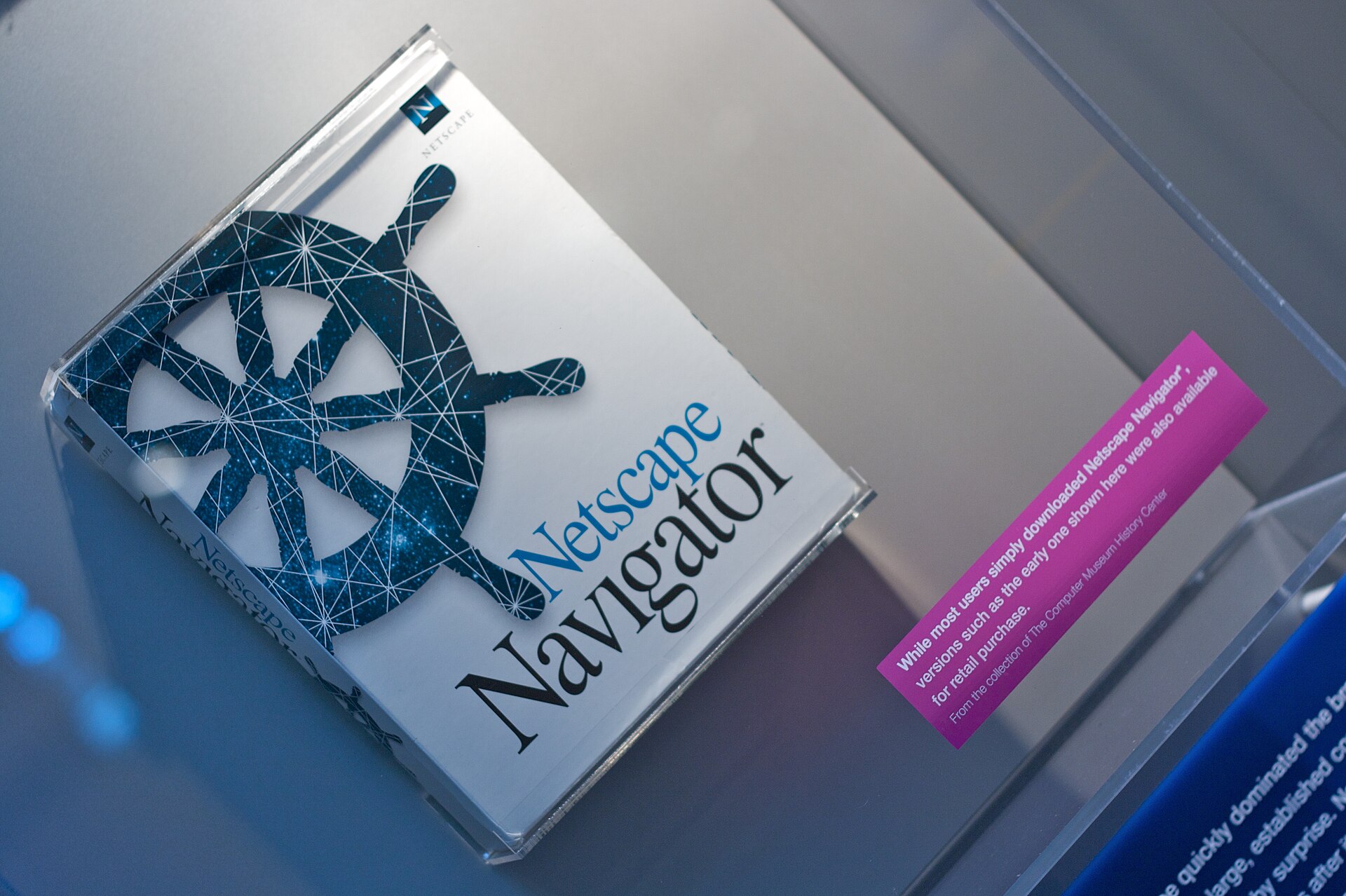
The Navigator box makes that transition tangible. A browser could still be a product you bought, unpacked and consciously installed. During the browser war it increasingly became an invisible part of the computer already sitting on your desk.
Internet Explorer moves into the desktop
Internet Explorer 4 in 1997 brought the browser and Windows Explorer closer together, visually and technically. With the optional Windows Desktop Update, folders could behave like web pages and Active Desktop could display web content on the desktop. Windows 98 went further: IE was present, prominent and, Microsoft argued, part of the operating system.
This integration gave Microsoft more than a shortcut. PC manufacturers and users could not easily treat IE like an ordinary program. Findings in the US Microsoft case described how licence terms, default settings and technical connections made it harder to remove the browser or give Netscape equal visibility.
Dutch perspective · best viewed with…
The browser war appeared at the bottom of the home page
Dutch web builders also had to pick a side. Personal home pages, club sites and small business pages carried badges reading ‘Best viewed with Netscape Navigator’ or ‘Best viewed with Internet Explorer’. An ideal display resolution often appeared beside them: 800 × 600 pixels, or even 640 × 480.
BEST VIEWED WITH
NETSCAPE
BEST VIEWED WITH
EXPLORER
HIGH COLOR RECOMMENDED
Such a badge was more than decoration. It revealed that the builder had mainly tested the page in one environment — and passed the problem to the visitor: install another browser if this site does not work. The National Library of the Netherlands preserves more than 3,000 XS4ALL home pages from 1993–2001. These personal pages show particularly clearly how browser choice, HTML experimentation and Dutch internet culture overlapped.
The badges above are new CSS reconstructions inspired by 1990s visual language; they are not copied from the KB collection.
Explore the KB collection of XS4ALL home pages →The contest moves into the courtroom
In May 1998 the US Department of Justice and twenty states sued Microsoft. The central issue was not that Internet Explorer was good, free or popular, but that Microsoft used its power in PC operating systems to restrict competition in browsers.
The government says Microsoft uses Windows to favour Internet Explorer.
The court finds monopoly abuse; an order to split the company follows.
The break-up is reversed. Microsoft accepts conduct rules and oversight.
The case partly revolved around the details that looked so harmless at home: which icon was visible, which browser opened by default and how much freedom a computer manufacturer possessed. Microsoft won the browser market, but the methods it used acquired a legal boundary.
Defeat contained the beginning of a return
In January 1998 Netscape decided to release the source code of the next Communicator version. On 31 March code became available through mozilla.org. It did not produce a fast successor immediately: the old code was difficult to modernise and the new Gecko engine took years of work. Even so, this became Netscape’s most important legacy.
AOL acquired Netscape in 1999. Navigator continued to lose ground while Internet Explorer dominated the desktop around the turn of the century. Mozilla, however, survived as an open project. Firefox would eventually emerge from that long detour — the subject of chapter 9.
A commercial defeat becomes the start of an open counterforce.
The winner also set the pace
With IE6 in Windows XP, the war seemed over in 2001. For many sites Internet Explorer became the only environment that truly mattered. This made the Web simpler for builders in the short term, but more dependent on one supplier. Innovation slowed, and proprietary IE technology remained embedded in companies and public organisations for many years.
The first browser war proved two things that would return later: a browser is never merely a window, and a standard only has value when competing browsers implement it in the same way.